
Selkirk Mountains Ancient Forest Park Proposal
When the government protected the Incomappleux part of VWS’s Selkirk park proposal, it lopped off the area used by endangered mountain caribou that has 14,148 hectares of old growth Inland Temperate Rainforest with huge trees, and 35,972 ha. of old growth spruce balsam. It omitted the rivers and mountain passes that provide crucial connectivity for the area’s grizzly bears, mountain caribou, wolverines and many other species. Last year, the government’s old growth Panel recommended logging deferrals for 13,207 hectares of at risk old growth within the unprotected part of the proposal. This is why the still unprotected old growth corridors were repackaged this year in a new, 102,000 hectare proposal called the Selkirk Mountains Ancient Forest Park Proposal.
Click here to read the proposal
Click here for the full update in the 2024 newsletter
Read below for archival information on the original proposal.
Selkirk Mountain Caribou Park Proposal
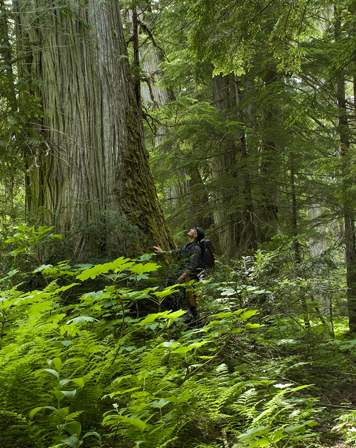 With the ancient forest of the Incomappleux and adjacent old growth corridors, a population of about 30 endangered mountain caribou, hundreds of species of lichens, rare plants, core habitat for blue-listed grizzly bears and wolverines, and spawning grounds of the bull trout of Kootenay Lake and the Arrow Lakes Reservoir: this is the Selkirk Mountain Caribou Park Proposal. The campaign to protect the primeval Inland Temperate Rainforest of the Incomappleux Valley and connecting old growth has been ongoing since the early 2000’s. Director Craig Pettitt has aged the largest trees at 1,800 years old. The Valhalla Wilderness Society begins 2011 with the release of this 28-page report chock full of maps and colour photographs.
Download the Fact Sheet (2 pages – PDF)
Download the Proposal (PDF)
Nineteen Environmental Groups Declare State of Emergency for B.C.’s Mountain Caribou
Nineteen environmental groups signed a joint submission (Nov/06) to the Species at Risk Coordination Office and have now declared a state of emergency. Mountain caribou populations are declining rapidly, the recovery process has almost run out of time, and the current draft Strategy is very far from what is needed to save the mountain caribou.
See Joint Caribou Submission (Download .pdf 28k)
Crisis for Wildlife of Southeastern BC
The BC government released a report by its Mountain Caribou Science Team containing recommendations that could lead to shocking consequences. Options are presented that are based primarily upon increased killing of the predators and competitor species of the mountain caribou, with little or no new protection of habitat.
VWS bulletin on Mountain Caribou Science Team report (696k .pdf)
Large Carnivore Conservation by the Valhalla Wilderness Society (712k .pdf)
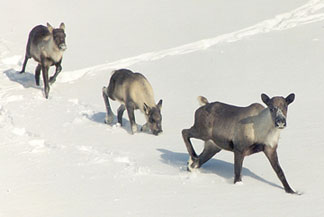 BC has the world’s only mountain caribou and they live in the Inland Rainforest Region. The mountain caribou depends upon old-growth forest for its survival. As a result of excessive logging, it is in serious danger of going extinct. With the recent functional extinction of the two southernmost herds, the Central Selkirk herd is now the most viable of the southern herds.
Forty Two Scientists Urge Full Protection of Old-Growth Forest to Save Mountain Caribou
Forty-two biologists and botanists have signed a petition urging British Columbia and Canada to fully protect old-growth forest across the range of the endangered mountain caribou.
Valhalla Wilderness Society Proposes a New Park
to Protect Old-Growth Forest in the Central Selkirk Mountains
The last remaining habitat for a herd of 30 endangered mountain caribou in the Central Selkirk Mountains is open for continued logging in the coming year. Although the provincial and federal governments are conducting a recovery process for the mountain caribou, they have done nothing to prevent another year of destruction that will take the animals’ life support out from under them. Finally, the Valhalla Wilderness Society has proposed the Selkirk Mountain Caribou Park, as well as Recovery Areas for the rehabilitation of habitat that has already been clearcut.
Fifty-One Scientists Urge Full Protection of Old-Growth Forest to Save Mountain Caribou
Fifty-one biologists and botanists have signed a petition urging British Columbia and Canada to fully protect old-growth forest across the range of the endangered mountain caribou.
Fifty-one Scientists’ Petition to Government
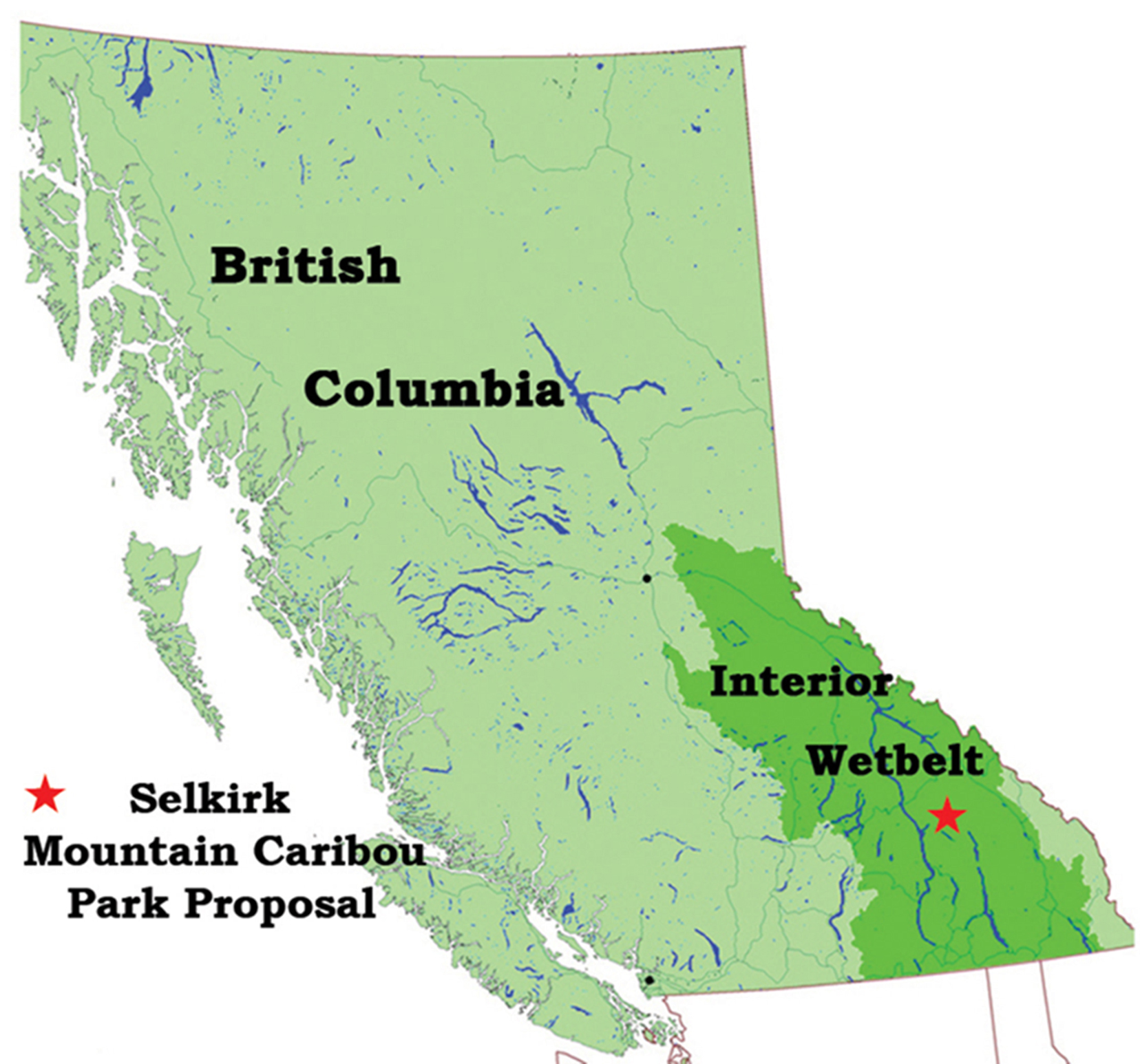 The Valhalla Wilderness Society is proposing a 156,461-hectare park in critical mountain caribou and grizzly bear habitat. This will include:
- Preservation of most of the critical habitat of the Central Selkirk mountain caribou.
- Recovery areas for Grizzly bear-Kokanee salmon ecosystems on the Lardeau, Incomappleux and Duncan Rivers.
- Preservation of BC’s most southerly Inland Rainforest with trees up to 1,800 years old and many recently discovered species of lichens new to science.
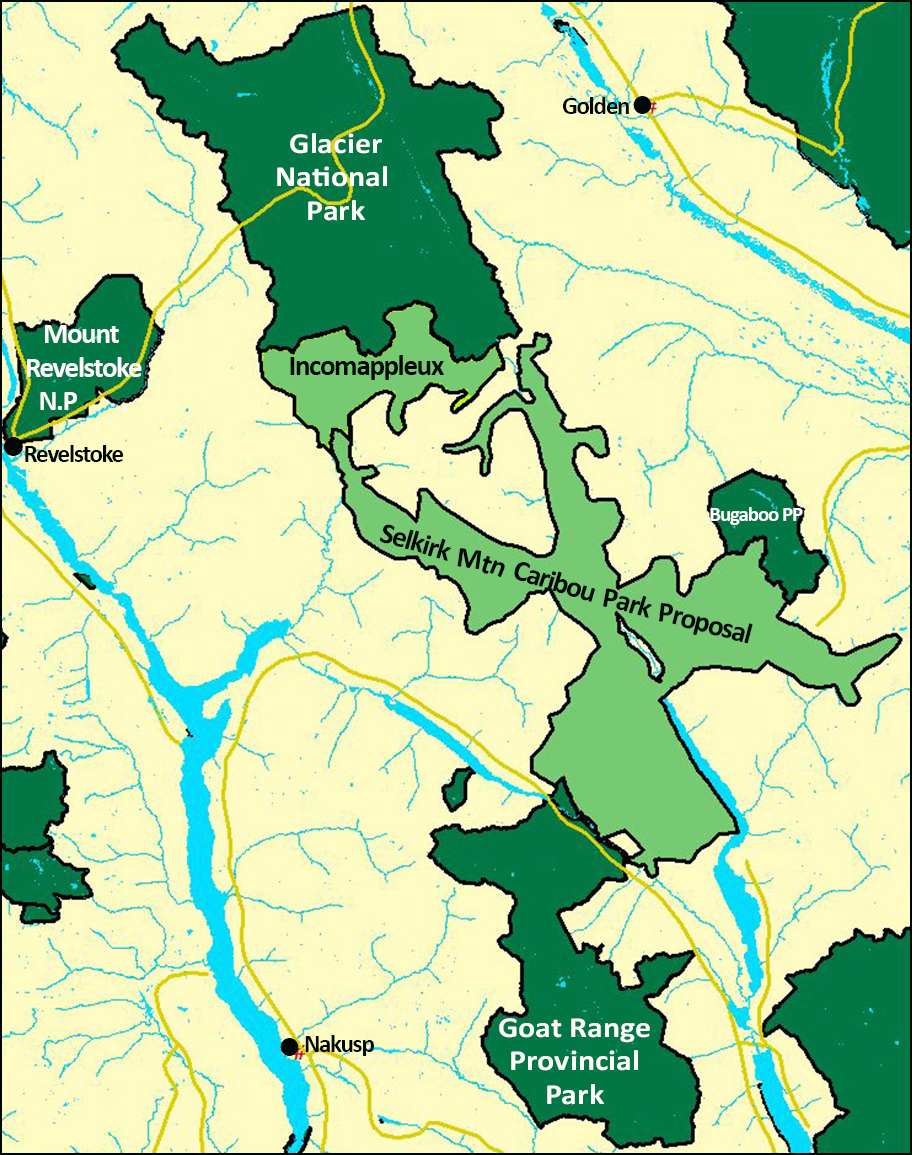 The key to protecting mountain caribou is large, intact areas of old-growth forest. The Central Selkirks have a number of protected areas, but in this mountainous region the parks contain large amounts of rock, ice, alpine meadows and sparsely treed subalpine slopes. Most of the adjoining forest at mid and low elevations was excluded from the parks so the timber industry could log it. But the caribou need that forest so that is where they tend to stay. The red on the map below shows clearcuts encroaching on the Central Selkirk herd’s critical habitat. The Valhalla Wilderness Society proposal has excluded some of the largest areas of rock and ice because this is a proposal specifically for the protection of old-growth forest.
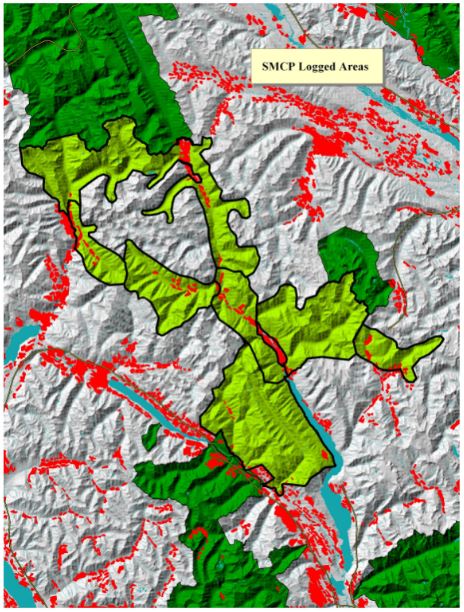
Mountain caribou are endangered because the old-growth forest is endangered. In losing our old-growth, we are also losing other old-growth dependent species. For instance, many species of rainforest lichens in the Central Selkirks are dependent upon old-growth forest.
67% of the Inland Rainforest Region is forest, but only 17% of the region is old-growth forest that is intact (continuous for 1,000 hectares or more).
About 16% of the region is in protected areas, but only 4.5% of the region is protected, intact, old-growth forest.
The northern half of the region has 2.5 times more protected, intact old-growth than the southern half.
The Valhalla Wilderness Society proposal has been designed to include rare stands of ancient cedar-hemlock forest such as the upper Incomappleux Valley. Recently, nine lichen species new to science were found there. Scientists are studying another 40 potentially new species.
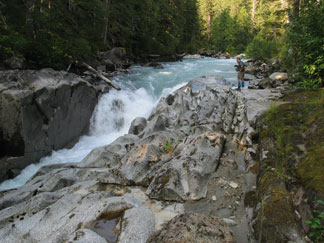 This is in the Incomappleux Valley. There was once a major caribou travel corridor in the valley, but most of it was logged and no one has seen a caribou in the remaining intact forest. Still, it is the most southerly example of rainforest in the BC Interior and it has many 500-1,000-year old trees. Evidence indicates the oldest ones may be 1,800 years old or more. Many of the nearly 300 species of lichens that live there are confined to lower-elevations and many may be wiped out if the old-growth continues to be logged. Logging has left very little of this legacy of ancient forest in the southern part of this region, and the Selkirk Mountain Caribou Park Proposal is where it can be found.
Watch Primeval: Enter the Incomappleux, and TAKE ACTION